6063-T5 vs 6061-T6 for Kitchen Cabinet Profiles
Updated: 23 Sep 2026
Both are 6000-series aluminum alloys and can be used for extruded aluminum products. However, they have different characteristics in strength, extrusion performance, surface finishing and cost.
For most decorative kitchen cabinet profiles, 6063-T5 is usually the more practical choice, while 6061-T6 may be considered when higher mechanical strength is required.
So how should cabinet manufacturers, furniture factories and project buyers choose between them?
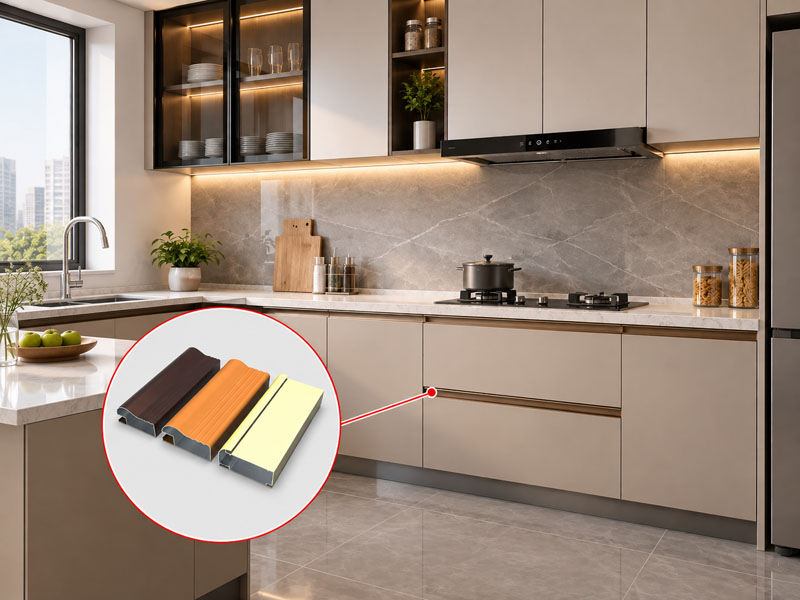
Quick Comparison: 6063-T5 vs 6061-T6
|
Factor |
6063-T5 |
6061-T6 |
|
Strength |
Moderate |
Higher |
|
Extrusion Performance |
Excellent |
Good |
|
Complex Profile Shapes |
Very suitable |
Possible, but less suitable for some complex sections |
|
Surface Finish |
Excellent |
Good |
|
Anodizing |
Excellent appearance |
Good |
|
Powder Coating |
Suitable |
Suitable |
|
CNC Machining |
Suitable |
Very suitable |
|
Typical Cabinet Use |
Door frames, handles, trims, decorative profiles |
Structural or higher-strength components |
|
Cost |
Generally more economical |
Generally higher |
The important point is that higher strength does not automatically mean a better kitchen cabinet profile.
The correct alloy depends on how the profile will actually be used.
Why Is 6063-T5 Commonly Used for Kitchen Cabinet Profiles?
6063 is one of the most widely used alloys for architectural and decorative aluminum extrusions.Its biggest advantage for kitchen cabinet manufacturers is the balance between extrudability, surface quality and sufficient strength.
Kitchen cabinet profiles often have relatively detailed cross-sections. Examples include:
Aluminum cabinet door frames
Glass door frame profiles
G-shaped and J-shaped handles
Invisible handle profiles
Cabinet edge profiles
Panel frame profiles
Decorative trims
These products are not selected based on maximum mechanical strength alone.
Profile shape, dimensional accuracy, surface appearance and compatibility with cabinet panels and hardware are equally important.
Better for Complex Extruded Sections
Kitchen cabinet profiles can contain grooves, channels, thin sections and detailed decorative structures.
6063 has excellent extrusion characteristics, making it well suited to producing these types of profiles with consistent cross-sectional dimensions.
For manufacturers ordering customized cabinet profiles, this can also make mold development and extrusion production more practical.
Excellent Surface Appearance
Kitchen cabinet profiles are visible components of the finished furniture.
Their appearance therefore matters.
6063 aluminum provides a good surface for finishes such as:
Clear anodizing
Black anodizing
Champagne anodizing
Powder coating
Brushed finishes
Wood-grain finishes
This is one reason 6063-T5 is frequently selected for modern kitchen cabinet door frames and handle systems.
When Should You Consider 6061-T6?
6061-T6 generally provides higher mechanical strength than 6063-T5.
This makes it useful when a cabinet component has more demanding structural requirements.
For example, 6061-T6 may be considered for:
Heavier structural components
Profiles carrying greater mechanical loads
Components requiring extensive CNC machining
Special cabinet structures with higher rigidity requirements
Custom furniture systems where strength is prioritized over decorative extrusion performance
However, this does not mean every cabinet profile should be upgraded from 6063-T5 to 6061-T6.
For a decorative cabinet door frame, for example, using a higher-strength alloy may provide little practical benefit if the 6063 profile already meets the structural requirements.
Does 6061-T6 Make a Cabinet Door Stronger
Potentially, but the alloy is only one part of the structure.
The actual rigidity and durability of an aluminum cabinet door also depend on:
Profile wall thickness
A properly designed profile with an appropriate wall thickness can perform very differently from an excessively thin section.
Profile cross-section
Ribs, chambers, grooves and overall geometry affect rigidity.
Door dimensions
A small cabinet door and a large full-height door place different demands on the frame.
Panel or glass weight
The weight of glass, aluminum panels or other inserts affects the load carried by the frame.
Corner connections
Poorly designed or assembled corner joints can become weak points even when a stronger aluminum alloy is used.
Hardware
Hinges, connectors and handles also influence the performance of the complete cabinet door.
Therefore, buyers should avoid selecting kitchen cabinet profiles based only on the alloy number.
6063-T5 vs 6061-T6 for Anodized Cabinet Profiles
For decorative anodized kitchen profiles, 6063-T5 is often preferred.
Its extrusion and finishing characteristics make it particularly suitable for visible aluminum components where surface consistency is important.
Typical anodized colors include:
Silver, black, champagne, bronze and other customized colors.
6061 can also be anodized, but when the primary requirement is an attractive decorative extrusion rather than higher structural strength, 6063 is generally the more practical material.
Buyers should also remember that the final appearance depends on more than the alloy.
Extrusion quality, surface preparation, anodizing process control and acceptable color tolerance between production batches all matter.
For large cabinet projects, it is advisable to confirm the required finish and color sample before mass production.
.jpg "Aluminum kitchen cabinet profile")
What About Powder-Coated Kitchen Cabinet Profiles
Both 6063 and 6061 can be powder coated.For kitchen applications, powder coating provides a wide range of color options and helps protect the aluminum surface.
Popular cabinet finishes include:
Matte black
White
Champagne
Grey
Gold
Customized RAL colors
In this case, the decision between 6063-T5 and 6061-T6 should still be based primarily on the profile's structure and mechanical requirements rather than the coating itself.
Which Alloy Should You Choose
For most kitchen cabinet manufacturers, the selection can be simplified:Choose 6063-T5 when:
The profile is mainly used for cabinet door frames, glass frames, handles, trims or decorative components, and good extrusion quality and surface appearance are important.
Consider 6061-T6 when:
The component has higher structural or mechanical requirements, requires greater strength, or involves specific machining and engineering requirements.
For many standard kitchen cabinet applications, 6063-T5 provides a better balance of extrusion performance, appearance, strength and manufacturing cost.
But alloy selection should always be considered together with wall thickness, cross-sectional design, door dimensions and application.
What Information Should You Send to an Aluminum Profile Supplier
Before requesting a quotation for custom kitchen cabinet profiles, prepare the following information:Profile drawing or sample
Required alloy and temper, if specified
Profile dimensions
Wall thickness
Required length
Surface finish and color
Cabinet application
Panel or glass thickness
Required machining
Order quantity
If you are unsure whether 6063-T5 or 6061-T6 is suitable, providing the profile drawing and application information allows the manufacturer to evaluate the production requirements more accurately.
Custom Aluminum Kitchen Cabinet Profiles from Shenghai
Shenghai manufactures customized aluminum profiles for kitchen cabinet manufacturers, furniture companies, distributors and project buyers.Our capabilities cover aluminum extrusion, mold development, cutting, drilling, CNC machining, anodizing and powder coating, allowing profile production and secondary processing to be coordinated according to your cabinet system.
Available products include aluminum profiles for:
Cabinet door frames
Glass cabinet doors
G / C / J handle profiles
Invisible handles
Cabinet panel frames
Edge and decorative profiles
Customized cabinet structures
Common materials include 6063-T5/T6 and 6061-T6, with customized dimensions, wall thicknesses, finishes and colors available according to project requirements.
Send us your profile drawing, dimensions, finish, quantity and application to discuss a suitable aluminum profile solution for your kitchen cabinet project.