Folding Door VS Sliding Door, Which is Better for Desert
Updated: 12 Feb 2026
The Core Definitions and Differences Between Folding Doors and Sliding Doors
What is a folding door?
A folding door consists of multiple door panels connected by hinges, with a foldable, sliding track. The multiple door panels are linked together by the hinges to form a whole. When opened, the door panels fold to one or both sides, allowing for a large, fully open opening, excellent ventilation, and maximizing space utilization. However, folding doors do not need to be fully folded every time they are used.What is a sliding door?
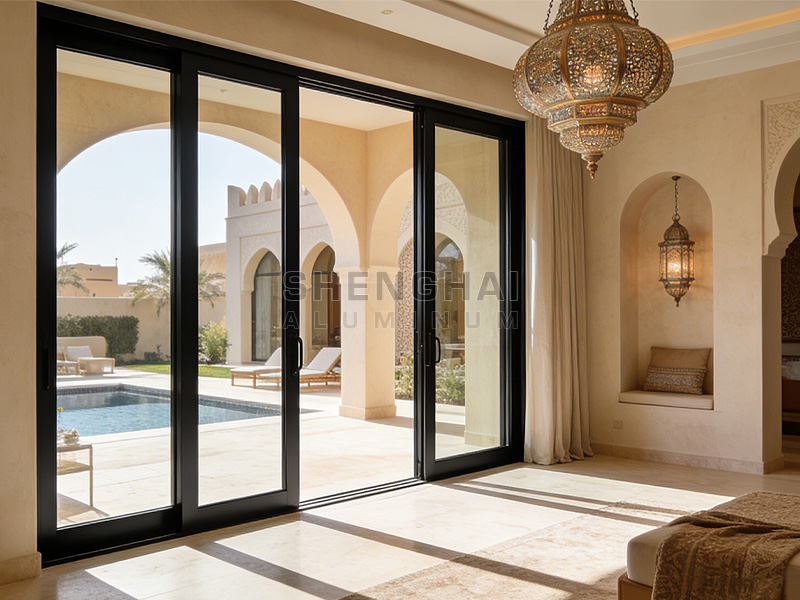
A sliding door consists of two or more doors that slide left and right using bottom rollers and a top rail. When open, the door panels slide along the track without occupying extra space outside the doorway. The core moving parts are only the rollers and the track, making the structure relatively simple.
Differences:
Opening Method: Folding doors involve multiple doors folding in tandem, while sliding doors slide horizontally.
Opening Rate: Folding doors can achieve an opening rate of over 90%, while sliding doors are typically ≤50%.
Space Occupancy: Folding doors require reserved space for the door panels, while sliding doors require only wall or doorway space on one side of the track.
Advantages and Disadvantages of Folding Doors and Sliding Doors
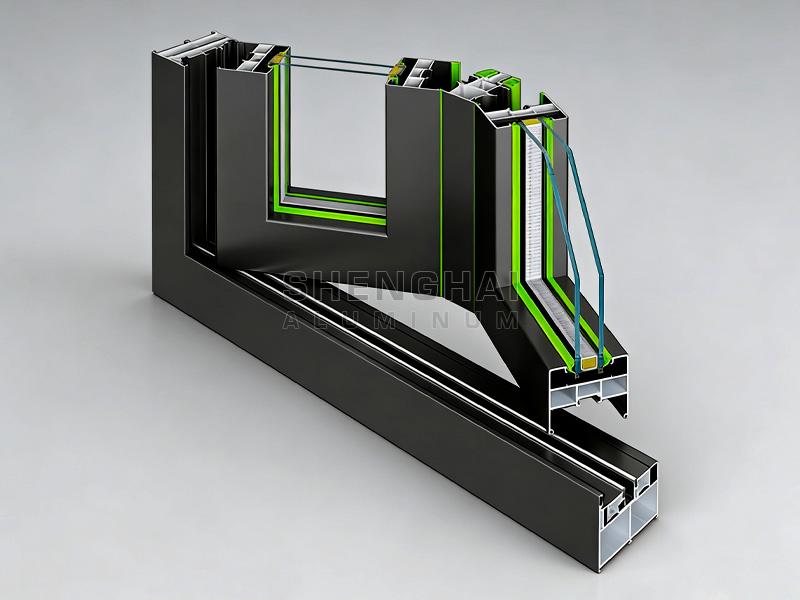
Wind and Sand Resistance and Sealing PerformanceFolding doors: Because multiple door panels are connected by hinges, there are many and dispersed sealing points, resulting in numerous seams between the door panels. Even with sealing strips, under long-term strong winds, sand erosion, and frequent opening and closing, the strips are prone to accelerated aging, and sand and dust easily accumulate at the folding hinges and tracks, gradually reducing sealing performance over time.
Sliding doors: The structure is relatively simple, with a tighter connection between the fixed and moving panels. The sealing structure between the door panel, frame, and track is more concentrated and seamless. Combined with multiple sealing strips and a dustproof track with a dust-proof edge on the bottom rail, they effectively resist wind and sand intrusion, offering better airtightness and making them a superior choice for wind and sand protection.
High Temperature Resistance and Deformation Resistance
Folding Doors: With a complex structure and multiple door panels paired with a sophisticated hardware system, their overall resistance to deformation is relatively weak in the extreme temperature variations of the desert. The desert experiences large temperature differences between day and night; high daytime temperatures cause the profiles to expand, while low nighttime temperatures cause them to contract. Door panels connected by multiple hinges are prone to loosening at the joints due to thermal expansion and contraction. Profile deformation can also indirectly exacerbate hinge sticking, affecting the smoothness of opening and closing. Therefore, extremely high requirements are placed on the strength of the profiles, processing precision, and the high-temperature-resistant materials and processes used in the hardware.
Sliding Doors: Their simple structure provides stronger overall resistance to deformation. The door panels bear force evenly, resulting in greater overall resistance to thermal expansion and contraction. The core stress points are the pulleys and tracks, maintaining smooth opening and closing even under temperature changes. Their long-term stability is generally better than that of folding doors.
Heat Insulation and Sun Protection Performance
Folding Doors: With the same profile and glass configuration, basic heat insulation is comparable to sliding doors. However, in actual use, the overall heat insulation efficiency is often lower than the theoretical value. When combined with thermally broken aluminum profiles and double-glazed tempered glass, the heat insulation and sun protection performance of a single door panel are comparable to those of a sliding door. However, gaps at the joints of multiple doors can form "thermal bridges," accelerating heat exchange between indoors and outdoors, resulting in slightly higher indoor cooling energy consumption at high temperatures. Furthermore, the large opening design exposes a larger glass surface to sunlight; without a sun-protective coating, the actual UV-blocking effect may be lower than the theoretical value.
Sliding Doors: More stable heat insulation and sun protection, and superior energy efficiency. The multi-cavity structure of thermally broken aluminum sliding doors, combined with double-glazed tempered glass, structurally blocks heat conduction and reflects over 90% of UV rays. The seamless closure structure of single or double doors provides more complete heat insulation, effectively reducing indoor heat absorption at high temperatures and lowering air conditioning energy consumption. The stability of heat insulation and sun protection is far superior to that of folding doors.
Viewpoint
Folding doors: When fully open, they offer unobstructed panoramic views, maximizing the desert landscape and providing a superior visual experience.
Sliding doors: When open, one or more doors are always closed, obstructing the view and preventing a truly unobstructed panoramic experience. The viewing experience is not as good as with folding doors.
Space Considerations:
Folding Doors: When opened, the door panels fold and close, taking up minimal space and maximizing the use of the doorway area. Suitable for scenarios requiring frequent full opening.
Sliding Doors: When opened, the door panels slide along a track, always partially obstructing the doorway or occupying space on one side of the wall. Their space utilization is slightly lower than that of folding doors.
Maintenance
Folding Doors: Long and complex tracks, hinges, guide mechanisms, and other components are prone to sand accumulation and jamming. Maintenance requires professional disassembly and cleaning, and replacement parts are costly, leading to high maintenance frequency and long-term costs.
Sliding Doors: The core moving parts are only the pulleys and tracks, making potential faults easily visible. Routine maintenance consists only of cleaning sand and dust from the tracks and replacing worn pulleys; operation is simple, and maintenance costs are low.
|
Performance |
Folding Doors |
Sliding Doors |
|
Wind Resistance |
Class 8-9 |
Class 9-10 |
|
Air Tightness |
Good initially, but degrades over time due to sand accumulation and aging |
Excellent and remains stable over the long term |
|
UV Resistance |
≥95% |
≥95%, with greater stability |
|
High Temperature Resistance |
Acceptable, but panels may loosen and hardware may jam |
Excellent; the structure remains stable and does not deform |
|
Heat Insulation Coefficient (K value) |
1.8-2.2 W/(㎡・K) |
2.0-2.5 W/(㎡・K) |
|
Space Utilization |
High (opening ratio >90%) |
Moderate (opening ratio ≤50%) |
|
View |
Unobstructed panoramic view |
Partially obstructed |
|
Maintenance Cost |
High |
Low |
How to Make the Right Choice in Desert Regions
Based on the above comparison, you can accurately match your project to its core needs and suitable scenarios:Prioritizing Folding Doors:
Core Requirements: Maximizing views and space utilization, while being able to withstand future maintenance costs.
Suitable Scenarios: Desert inland areas with low wind speeds and no frequent strong winds or sandstorms. Suitable for projects such as high-end hotel terraces and villa courtyards that require frequent full-scale landscape development and a professional maintenance team.
Prioritizing Sliding Doors
Core Requirements: Durability, wind and sand resistance, stable sealing performance, with a focus on long-term durability, heat insulation and energy saving, and low maintenance.
Suitable scenarios: Core desert areas with frequent sandstorms and strong ultraviolet radiation. Residential, commercial buildings, office spaces, and other projects with high requirements for ease of maintenance and long-term stability.
In door and window selection in desert areas, there is no absolute superiority or inferiority between folding and sliding doors; the choice depends on the best fit for your needs, usage scenarios, and environmental conditions. If you prioritize panoramic views and spaciousness, and your project budget allows for professional maintenance, folding doors are an excellent choice. If you value durability, wind and sand resistance, and cost-effectiveness, and need to reduce long-term maintenance costs, sliding doors are a more suitable and reliable choice for the harsh desert environment.
Whether you're looking for folding or sliding doors, Shenghai Aluminum offers high-quality aluminum alloy profile solutions. As a professional aluminum profile manufacturer with over 15 years of experience, we not only provide high-quality aluminum alloy profiles that meet ISO standards, but also offer customized, integrated solutions from profiles to finished products to meet the specific needs of desert regions. Our products cover the full range of door and window systems required, ensuring reliable quality and professional service for your projects in harsh environments.