How To Install Aluminium Glass Sliding Door
Updated: 24 Apr 2026
How to Easily Install an Aluminum Sliding Door in 7 Steps
Glass aluminum sliding doors are widely used in balconies, kitchens, bathrooms, and interior partition areas due to their aesthetic appeal, durability, and space-saving design. Proper installation not only ensures smooth door operation but also effectively extends its service life.If you have some DIY experience, you can easily complete the installation by following the 7 steps outlined below.
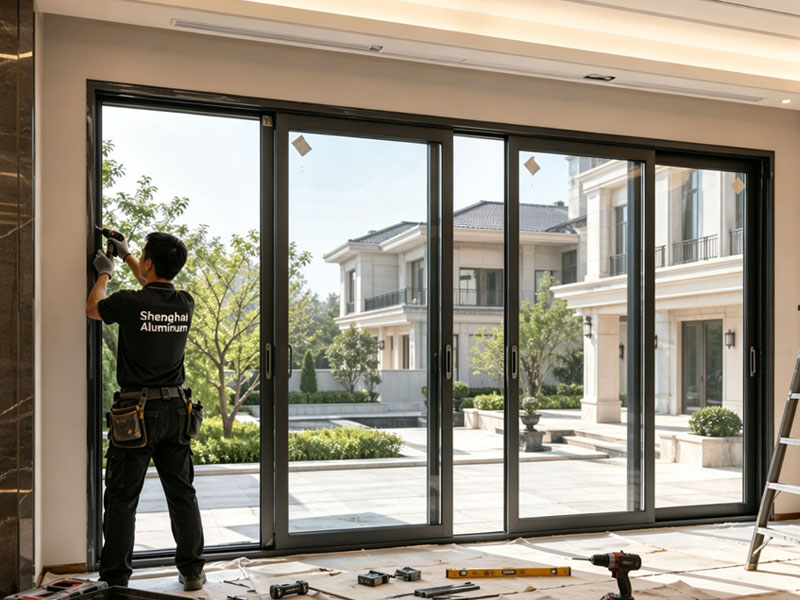
Before installation, the first step is to precisely measure the dimensions of the door opening; this is the most critical step in the entire installation process.
Use a tape measure to record the following data:
Width of the door opening
Height of the door opening
Wall thickness
Whether the floor is level
It is recommended to measure the width of the opening at the top, middle, and bottom separately to ensure consistent dimensions.
If you are installing a new door frame, verify that the walls are plumb (vertical) and that the corners form perfect 90-degree right angles.
Note: It is recommended to keep dimensional tolerances within 2mm to ensure a smoother installation later.
Step 2: Install the Upper and Lower Tracks
The track system directly impacts the smoothness of the sliding door's operation.
Typically, an aluminum sliding door system consists of two components: an upper track and a lower track.
First, mark the installation positions for the tracks based on your measurements; then, use an electric drill to create pilot holes and secure the tracks using expansion bolts.
Points to note during installation:
The upper and lower tracks must be parallel to each other.
Use a spirit level to verify that the tracks are perfectly level.
The lower track must sit firmly and flush against the floor surface.
If the tracks are installed unevenly, the door panels may jam or slide unintentionally later on.
Step 3: Install the Roller Assemblies
The rollers are the core components responsible for the smooth operation of the sliding door.
Install the rollers into the designated slots located at the top and bottom edges of the door panels.
Installation tips:
First, mark the precise locations for the screw holes.
Fasten the screws loosely at first; do not tighten them fully (lock them down) immediately.
Leave some room for subsequent adjustments.
High-quality nylon rollers or "silent" rollers can effectively reduce operational noise.
Step 4: Install the Door Panels
It is recommended that two people work together to complete this step. Gently tilt the door panel, guide the upper rollers into the upper track, and then align the lower rollers with the lower track.
If you are installing a double-panel sliding door:
Install the fixed (stationary) door panel first.
Then, install the movable (sliding) door panel.
Ensure that the door panels can slide freely along the tracks.
Step 5: Install the Bottom Guide
The bottom guide prevents the door panel from swaying side to side, thereby enhancing its stability.
It is typically installed at the bottom of the door panel or on the adjacent wall surface.
Once secured with screws, check to ensure the door panel slides smoothly.
Step 6: Fine-tuning the Sliding Mechanism
Upon completion of the installation, a comprehensive inspection is required.
Does the door slide smoothly?
Are there any unusual noises?
Is the gap between the door and frame uniform?
Is the door panel plumb (perfectly vertical)?
If the door panel appears tilted, fine-tuning can be achieved by adjusting the rollers' height.
Step 7: Install Hardware Accessories and Limit Stops
Finally, install the relevant hardware accessories, including:
Door handles
Door locks
Anti-collision bumpers
Limit stops
Insect screens (optional)
It is recommended to install limit stops at both ends of the track to prevent the door panel from sliding off the rails.
Key Considerations When Installing Aluminum Sliding Doors
To ensure long-term performance and durability, it is advisable to pay close attention to the following points:The track must be perfectly level.
The rollers must be of high quality.
The dimensions of the door frame must be precise.
Hardware components should be rust-proof and corrosion-resistant.
For exterior doors, ensure proper sealing and waterproofing measures are implemented.
Common Installation Mistakes to Avoid
Inaccurate opening measurementsUnlevel bottom track
Low-quality rollers
Insufficient waterproofing/sealing
Loose screws
Incorrect alignment of glass panels
Even a minor installation error can result in poor sliding performance.
How to Choose the Right Aluminum Sliding Door
The performance and user experience of an aluminum sliding door depend largely on the choice of aluminum profiles. For buyers or large-scale engineering projects, the main focus is usually on two key aspects: profile thickness and surface treatment process.Profile Thickness
Since profile thickness directly affects the door's strength, stability, and load-bearing capacity, it is essential to select the appropriate thickness for the specific application.
1.0–1.2 mm: Suitable for lightweight applications such as interior partitions and wardrobe doors; offers low cost but limited load-bearing capacity.
1.4–1.6 mm (Most Popular Choice): Suitable for everyday residential applications, such as balcony doors and kitchen doors; offers the optimal balance between structural strength and cost-effectiveness.
1.8–2.0 mm: Suitable for high-rise residential buildings, commercial spaces, and large-format glass doors; provides superior structural stability and rigidity. 2.0mm and above: Engineering-grade applications—such as in hotels, office buildings, and for extra-large door systems—where enhanced stability is required.
When making a selection, one should consider the door dimensions, glass weight, and intended environment, rather than simply assuming that "thicker is always better."
Surface Treatment
For most buyers, surface treatment is not merely about aesthetics, but also about long-term durability and adherence to project standards.
Anodized: Offers superior scratch resistance and a modern metallic appearance.
Powder Coated: The most common choice, offering a wide array of color options.
Wood Grain: Ideal for decorative projects and spaces designed with a furniture-style aesthetic.
PVDF: Suited for outdoor and engineering-grade applications.
For balcony sliding doors and exterior systems, powder coating and PVDF are typically preferred for their superior weather resistance.
How to Enhance Waterproof Performance
For balcony and exterior sliding doors, effective waterproof sealing is essential.Recommended sealing components include:
Rubber weather strips
Silicone sealant
Drainage holes
Brush strips
Bottom threshold seals
These elements improve resistance to rain and enhance windproofing.
Applications of Aluminum Sliding Doors
Thanks to their space-saving design, excellent natural lighting, corrosion resistance, and modern aesthetics, aluminum alloy sliding doors are widely used in both residential and commercial spaces.Balcony Aluminum Sliding Doors
Commonly installed between living rooms and balconies, their large-format glass design enhances natural lighting and creates a sense of spatial openness, making them a mainstream choice in residential projects.
Kitchen Aluminum Sliding Doors
Ideal for kitchen partitions, they effectively block cooking fumes without occupying swing space, making them particularly well-suited for apartments and smaller living spaces.
Aluminum Bathroom Sliding Doors
Frequently used for shower enclosures and in areas requiring wet-and-dry separation, they offer excellent moisture and rust resistance, balancing both aesthetic appeal and practical functionality.
Office Partition Sliding Doors
Widely employed in conference rooms, office partitions, and commercial display areas, they maintain spatial transparency while enhancing the overall modern aesthetic of the environment.
Thanks to their diverse range of applications, aluminum sliding doors have become a go-to door and window solution for both residential and commercial projects.
Why Choose Aluminum Sliding Doors
Aluminum sliding doors have become a popular choice for both residential and commercial spaces due to their rust and corrosion resistance, lightweight yet high-strength construction, modern appearance, ease of installation, and long service life. Aluminum naturally possesses excellent resistance to moisture and corrosion, making it particularly well-suited for environments such as balconies, kitchens, and bathrooms. Furthermore, while lightweight, its structural integrity remains robust enough to accommodate the demands of large-format glass doors. Its sleek, fluid design lines align perfectly with modern architectural aesthetics; combined with ease of installation and low long-term maintenance costs, it has become the preferred window and door solution for an increasing number of projects.Thanks to their stylish appearance, corrosion resistance, smooth sliding operation, and space-saving advantages, glass aluminum sliding doors continue to enjoy high demand worldwide. Whether utilized as balcony doors or kitchen partitions in residential developments, or as office dividers, hotel fixtures, and retail storefronts in commercial spaces, aluminum glass sliding doors have become an indispensable element of modern architecture, gradually emerging as the top choice for both residential and commercial projects.
Driven by growing market demand for high-quality window and door systems, energy efficiency, and personalized customization, aluminum glass sliding doors hold immense potential for future growth in architectural decoration and engineering projects. Consequently, they are highly favored by traders, engineering contractors, window and door brands, and project procurement specialists alike.
As a professional aluminum manufacturer with over 16 years of experience in the window and door industry, Shenghai Aluminum specializes in the extrusion of aluminum profiles for windows and doors, mold development, surface treatments, and customized deep processing. Beyond supplying high-quality aluminum profiles, we also offer complete, ready-to-install window and door solutions tailored to our clients' specific requirements, ensuring compliance with the diverse standards of various markets and projects.
Whether you are a trader, a window and door brand, or a procurement manager for an architectural engineering project, if you are seeking a reliable supplier of aluminum profiles or a partner for finished window and door products, we invite you to contact us at any time. Shenghai Aluminum is committed to providing you with expert product recommendations, rapid quotations and comprehensive one-stop customization services to help ensure the efficient and successful realization of your projects.