How to Reduce Water Leakage in Aluminum Folding Doors
Updated: 17 Sep 2026
However, when a folding door is installed on an exterior opening, water resistance becomes an important consideration.
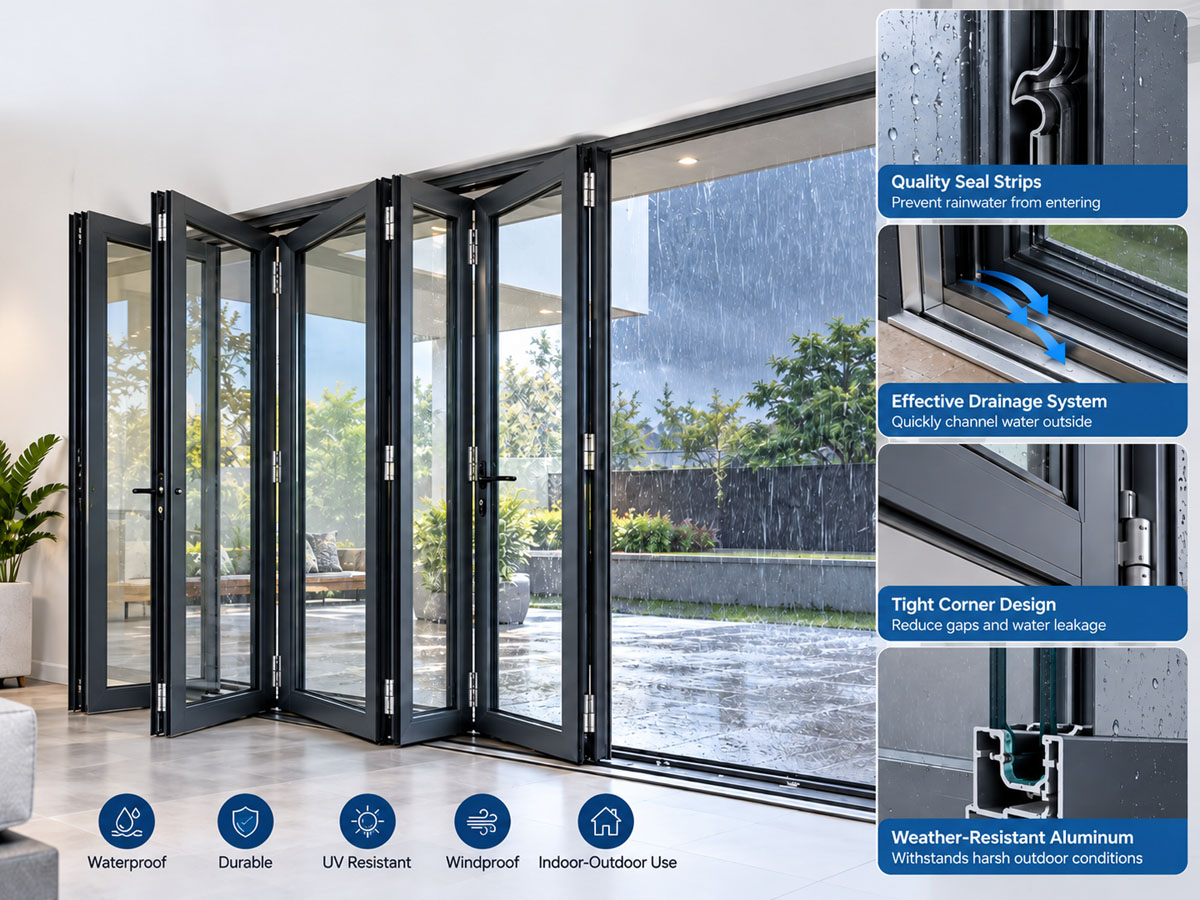
An aluminum folding door contains multiple moving panels, vertical joints, hinges, tracks, and sealing points. During heavy rain or wind-driven rain, these areas all need to work together to keep water outside.
If you are experiencing water leakage—or are choosing a new folding door for an exterior project—this guide explains what you should check and how to reduce the risk of leakage.
Why Do Aluminum Folding Doors Leak
Water leakage does not always mean the folding door itself is defective. It can be caused by the door configuration, sealing, drainage, adjustment, installation, or even the surrounding building structure.Common causes include:
Poor sealing between folding panels
Damaged, loose, or incorrectly compressed gaskets
Blocked bottom-track drainage
Incorrect threshold selection
Misaligned folding panels
Insufficient locking pressure
Poor sealing between the outer frame and wall
Outdoor flooring that directs water toward the door
Heavy wind-driven rain exceeding the intended weather performance of the door system
The first step is therefore to determine where the water is entering before trying to fix the problem.
1. Find the Source of the Water Leakage
After rain, inspect the folding door carefully instead of immediately applying more sealant.
Water Around the Bottom Track
If water collects in the bottom track and eventually enters the room, check whether the drainage holes are blocked or whether water can flow freely toward the exterior.
Water Between Folding Panels
If water appears along the vertical joints between panels, check the gaskets and whether the panels close evenly from top to bottom.
Water Around the Outer Frame
If the wall or floor around the outer frame becomes wet, the problem may come from the frame-to-wall installation joint rather than from the folding panels.
Water Around the Corners
Corners are particularly important because the vertical frame, bottom track, gaskets, and installation joints meet in a relatively small area.
Identifying the leakage point helps avoid unnecessary repairs and makes it easier to find the actual cause.
2. Choose an Aluminum Folding Door with Effective Drainage
For exterior folding doors, drainage is one of the most important parts of water management.
A well-designed aluminum folding door should not simply rely on seals to stop every drop of water. It should also provide a controlled path for water that reaches the bottom track to drain back outside.
Depending on the door system, this may include:
Bottom-track drainage channels
Drainage or weep holes
Separate internal and external water paths
Suitable threshold height
Proper drainage toward the exterior
The goal is simple: water should be discharged before it can accumulate and cross the interior side of the threshold.
Keep the Bottom Track Clean
Even a good drainage design will not work properly if the drainage path becomes blocked.
Dust, leaves, sand, insects, and construction debris can accumulate in the bottom track over time. Exterior folding doors should therefore be inspected and cleaned periodically, especially before seasons with frequent heavy rain.
3. Check the Seals Between Folding Panels
A folding door is different from a conventional single-panel door because it contains several moving joints.
For example, a four-panel folding door has multiple vertical connections that need to close and seal correctly every time the door is operated.
Quality sealing gaskets, such as EPDM seals, can help create continuous sealing around the panels and frame.
However, the number of seals alone does not determine water resistance.
What matters is whether the seals:
Are correctly positioned
Remain continuous at important sealing points
Make sufficient contact when the door closes
Are evenly compressed
Remain flexible and undamaged
If a gasket becomes loose, hardened, cracked, or deformed, it may no longer provide the intended sealing performance.
For exterior applications, a properly designed multi-sealing structure can provide additional protection against rain and air infiltration.
4. Make Sure All Folding Panels Close Tightly
Good seals cannot work effectively if the folding panels are not properly aligned.
Large folding door panels can carry considerable glass weight. Rollers, hinges, locks, and adjustment components must therefore keep each panel in the correct position.
When the door is fully closed, check whether:
The gaps between panels are even
The top and bottom gaps are consistent
The door locks smoothly
The seals contact the frame evenly
No visible gap appears between adjacent panels
A common problem is a panel that has moved slightly out of alignment. The upper part may close tightly while the lower part remains loose—or vice versa.
This uneven pressure can create a path for wind-driven rain.
In this situation, simply replacing the gasket may not solve the problem. The rollers, hinges, locking points, and panel alignment should also be checked and adjusted.
5. Choose the Right Threshold for Exterior Folding Doors
Threshold design has a direct relationship with weather protection.
Low and flush thresholds are attractive because they create a smoother transition between indoor and outdoor spaces. They are particularly popular for patios, balconies, restaurants, and modern villas.
However, the lowest threshold is not automatically the best choice for every project.
Before selecting the threshold, consider:
Is the folding door completely exposed to rain?
Is there a canopy or roof above the opening?
Does the area experience frequent heavy rain?
Is wind-driven rain common?
Can the outdoor floor drain water quickly?
Is a flush floor transition essential?
For a protected patio, a low-threshold solution may work well when properly designed and installed.
For a fully exposed exterior opening in an area with heavy rain or strong winds, water management and drainage performance should receive greater priority when selecting the threshold.
This is why the installation environment should be discussed with the folding door supplier before the final door configuration is confirmed.
6. Consider Wind-Driven Rain, Not Just Normal Rain
Rain does not always fall vertically.
During strong winds, rainwater can be pushed directly against the glass, frame, panel joints, and bottom track. This creates much more demanding conditions than light vertical rainfall.
Wind-driven rain should receive particular attention for folding doors used in:
Coastal buildings
Villas with large exterior openings
High-rise balconies
Hotels and resorts
Restaurants with outdoor terraces
Commercial buildings with wide openings
Tropical and high-rainfall regions
For these applications, buyers should consider the complete weather-resistance solution rather than selecting a folding door based only on appearance, color, or price.
The door structure, seals, drainage, threshold, glass, hardware, and installation environment all affect the final performance.
7. Check the Installation Around the Door Frame
Sometimes water appears around an aluminum folding door even though the door panels and seals are working correctly.
The problem may actually be around the installation opening.
Important areas to check include:
Connection between the frame and wall
Exterior sealant
Bottom corners
Sill area
Waterproofing around the opening
Outdoor floor height
Outdoor floor slope
For example, if the exterior floor slopes toward the folding door, rainwater may continuously collect against the bottom threshold.
Similarly, gaps between the outer frame and building opening can allow water to enter around the door rather than through it.
For this reason, installation should be considered part of the overall waterproofing solution.
8. Do Not Use Sealant to Solve Every Leakage Problem
Applying additional silicone is a common response when a door starts leaking.
Sealant is useful for certain installation joints, but it cannot correct every problem.
For example, additional sealant will not properly solve:
Blocked drainage holes
Misaligned panels
Damaged gaskets
Incorrect locking pressure
Poor threshold selection
Improper outdoor drainage
Applying sealant in the wrong place may even block an intended drainage path.
The correct approach is to identify the source of the leakage first and then repair the specific problem.
How to Reduce Water Leakage When Buying a New Folding Door
If you are purchasing new aluminum folding doors, preventing water problems starts before installation.
Do not select a door based only on its dimensions, color, and appearance.
For exterior applications, discuss the installation conditions with your supplier and confirm the following:
|
What to Check |
Why It Matters |
|
Opening size |
Affects panel configuration and overall door design |
|
Number of panels |
Determines the number of moving joints and sealing points |
|
Installation area |
Indoor, covered, or fully exposed conditions require different consideration |
|
Threshold design |
Influences drainage, accessibility, and weather protection |
|
Drainage system |
Helps discharge water collected in the bottom track |
|
Sealing system |
Helps reduce water and air infiltration around panels |
|
Glass option |
Affects panel weight, insulation, safety, and hardware requirements |
|
Hardware |
Rollers, hinges, and locks affect panel alignment and sealing pressure |
|
Rain and wind exposure |
Helps determine the required weather-resistance solution |
|
Project location |
Climate and environmental conditions should be considered |
For exterior projects, it is particularly useful to tell your supplier where and how the folding door will be installed.
A folding door for a covered interior courtyard and a folding door facing an exposed coastal balcony should not automatically be treated as the same application.
What Makes a Good Exterior Aluminum Folding Door?
There is no single component that makes a folding door waterproof.A reliable exterior aluminum folding door depends on several elements working together:
Stable door panels + effective seals + suitable threshold + bottom-track drainage + reliable hardware + correct panel alignment + proper installation
This is also why comparing folding doors only by aluminum frame thickness or price can be misleading.
When choosing a finished folding door, buyers should consider the complete door system and actual installation environment.
Finished Aluminum Folding Doors from Shenghai Aluminum
Shenghai Aluminum provides finished aluminum folding doors and windows for residential, commercial, and project applications.
Different folding configurations, glass options, finishes, hardware, sealing systems, and threshold solutions can be selected according to the opening size and project requirements.
Our aluminum folding doors can be used for applications such as:
Villas and residential buildings
Patios and balconies
Hotels and resorts
Restaurants and cafés
Offices
Commercial buildings
Large indoor-outdoor openings
For exterior projects, we recommend considering rain exposure, wind conditions, drainage, sealing, threshold requirements, and installation environment before confirming the final folding door configuration.
If you are planning an aluminum folding door project, you can send us your opening width and height, required number of panels, project location, glass requirements, opening direction, and installation environment.
Shenghai Aluminum can help you select a suitable finished aluminum folding door solution for your project.